

New Tank Syndrome: How to "Cycle" Your Aquarium Without Killing Fish
You bought a sparkling new tank, filled it with water, and added some beautiful fish. A few days later, the water is cloudy and your fish are gasping or dying. This is called New Tank Syndrome, and it's the single most common reason beginners lose their first fish. The good news: it's completely preventable once you understand the science.
Cycling a tank is the process of building a living biological filter inside your aquarium — specifically, two species of bacteria that convert toxic fish waste into safer compounds. It takes patience (typically 4 to 8 weeks) but it's the foundation every healthy aquarium is built on. Skip it and you're essentially keeping fish in a slowly accumulating toxic soup.
This guide walks through what's actually happening in a new tank, how to cycle without harming fish, how long it really takes, and how to read your test kit to know exactly when it's safe to add livestock. If you don't know your tank's exact volume, run it through our Aquarium Volume Calculator first — ammonia dosing during fishless cycling depends on accurate gallons.
The Problem: Invisible Toxins in Your Fish Tank
New aquariums are sterile environments. They lack the microscopic life needed to process waste. When fish release waste (ammonia), it builds up rapidly because there is nothing there to clean it up. Ammonia (NH3) is highly toxic and burns fish gills even in small amounts.
Concrete numbers: ammonia at 0.25 ppm is already stressful for sensitive fish. At 1.0 ppm most fish show distress within hours. At 2.0 ppm and above, fish develop chemical burns on their gills (you'll see redness or "burned" filaments) and many will die within a day or two. Worse, fish under ammonia stress lose immune function and become susceptible to ich, fin rot, and bacterial infections that often finish them off even after the ammonia is gone.
The trickiest part: ammonia is invisible and odorless. By the time your water looks cloudy or your fish are gasping at the surface, levels have usually been dangerous for days. The only way to actually know your ammonia level is a liquid test kit (test strips are unreliable for ammonia at low levels).
The Solution: The Nitrogen Cycle
To make the water safe, you need to grow colonies of beneficial bacteria — specifically Nitrosomonas (which eats ammonia) and Nitrobacter/Nitrospira (which eats nitrite). These bacteria live primarily inside your filter media, with smaller colonies on substrate, decor, and glass. This process of growing them is called "Cycling." Here is the 3-step lifecycle:
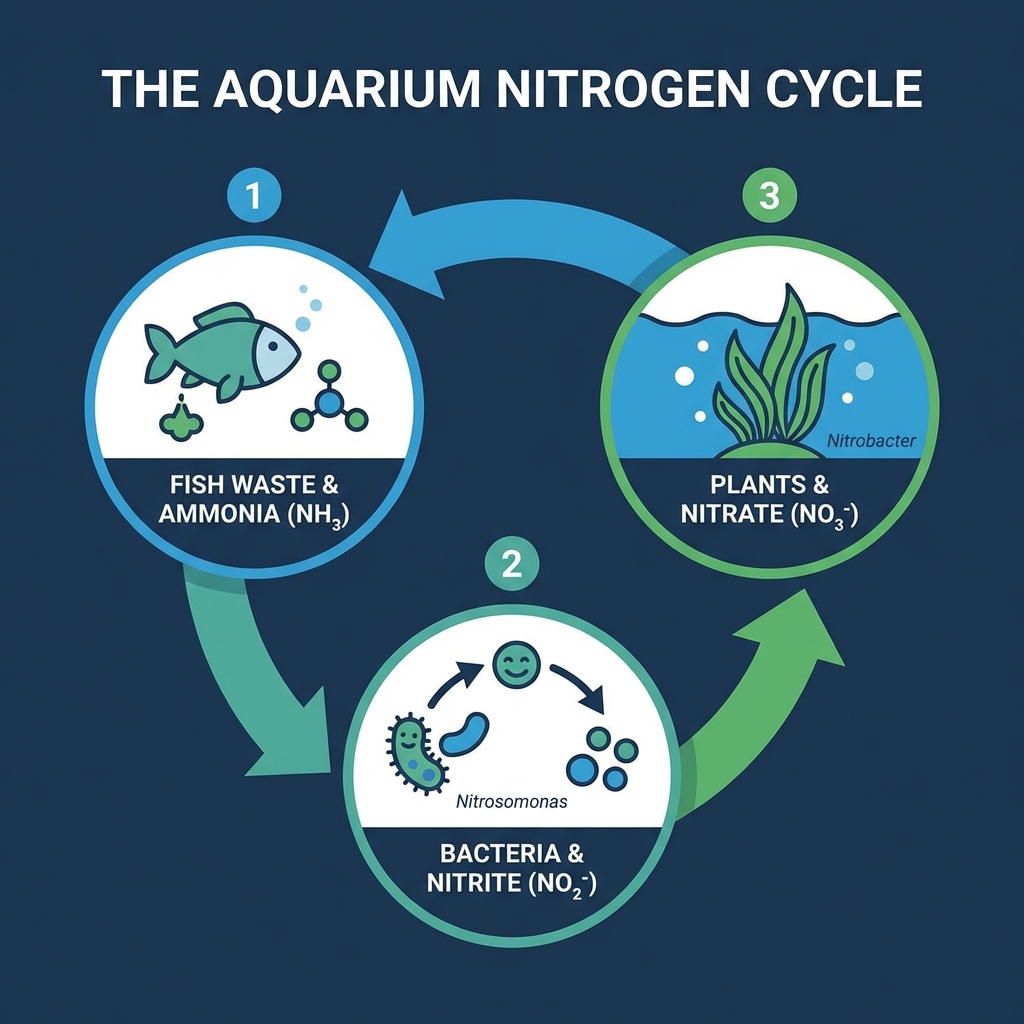
1. Ammonia (Toxic 💀)
Fish waste and uneaten food break down into Ammonia. This is the first spike in a new tank.
2. Nitrite (Still Toxic ⚠️)
A specific type of bacteria eats Ammonia and turns it into Nitrite. Unfortunately, Nitrite is also toxic to fish.
3. Nitrate (Safe ✅)
Finally, a second type of bacteria eats the Nitrite and converts it into Nitrate. Nitrate is relatively harmless in low levels and is removed by your weekly water changes.
Your beneficial bacteria mostly live inside your filter media, which is why choosing the right filter from our Filter Comparison Guide is critical — and why aggressive filter cleaning can crash a cycled tank. For a deeper dive into how these bacteria work and how to protect them, read our Beneficial Bacteria in Aquariums Guide.
Fishless Cycling: The Right Way to Start a Tank
The modern, humane way to cycle is fishless cycling — you grow bacteria before any fish enter the tank. The process:
- Set up the tank fully. Substrate, filter, heater, water dechlorinated, temperature at 78°F+ (warmth speeds bacteria growth).
- Dose pure ammonia to 2 ppm. Use unscented household ammonia (no surfactants) or commercial products like Dr. Tim's Ammonium Chloride. The bacteria need food — ammonia is their food.
- Test daily. Watch for ammonia to drop and nitrites to spike. This usually happens within 7 to 14 days.
- Re-dose ammonia back to 2 ppm any time it falls below 1 ppm. You're feeding the colony.
- Wait for nitrites to drop and nitrates to rise. This second wave usually takes another 2 to 4 weeks.
- Confirm the cycle is complete: dose ammonia to 2 ppm and check 24 hours later. If both ammonia AND nitrite read 0 ppm with nitrate rising, the cycle is done.
- Do a 50 to 75 percent water change to drop nitrates back below 20 ppm, then add fish slowly — never a full school at once.
Total time: 4 to 8 weeks for most tanks. Tanks seeded with mature filter media or bottled bacteria (Dr. Tim's One and Only, Seachem Stability, Tetra SafeStart) can finish in 1 to 3 weeks.
Fish-In Cycling: When You're Already Stuck With Fish
If you've already added fish without cycling first — common when starter kits ship with the implication you can stock immediately — you're now doing a "fish-in cycle." It's possible to do safely but requires daily attention:
- Test ammonia and nitrite every single day. Both should never exceed 0.25 ppm.
- Do a water change immediately any time either reads above that. Typically 25 to 50 percent.
- Use a water conditioner that detoxifies ammonia like Seachem Prime, dosed every 24 to 48 hours. Prime binds ammonia into a non-toxic form that bacteria can still consume.
- Don't feed heavily. Less food in equals less ammonia out. Skip a feeding day if levels are climbing.
- Be patient. The cycle takes longer this way (often 6 to 10 weeks) because you're constantly diluting the bacteria's food supply.
Add hardy starter fish only — species like guppies, zebra danios, and white cloud minnows tolerate the process better than tetras, corydoras, or any sensitive species.
How to Speed Up the Nitrogen Cycle
While bacteria grow on their own schedule, you can dramatically shorten the wait:
- Seed media from an established tank. If a friend has a healthy aquarium, ask for a used filter sponge or a cup of their gravel. This is the single fastest cycle accelerator — can cut weeks down to days.
- Bottled bacteria starters. Dr. Tim's One and Only and Tetra SafeStart Plus contain live nitrifying bacteria. Quality varies; refrigerated bottles from a reputable shop work better than boxes that have sat on a warm shelf for months.
- Keep temperature high. Bacteria multiply roughly twice as fast at 80°F as at 70°F. Set the heater warm during cycling, then drop to your target after.
- Add live plants. Plants consume ammonia directly, lowering the load. Hardy starter plants like Anubias, Java Fern, and Hornwort work even with no CO2.
- Don't overclean. Every gravel scoop and filter rinse removes bacteria. During cycling, leave things alone except for water changes when needed.
Reading Your Test Kit: Numbers That Matter
You'll be living with your test kit during cycling. Here's what each reading means:
- Ammonia (NH3) target: 0 ppm in a cycled tank. Anything above 0.25 ppm in a stocked tank is an emergency — do a water change.
- Nitrite (NO2) target: 0 ppm in a cycled tank. As toxic as ammonia. Same emergency response.
- Nitrate (NO3) target: Under 20 ppm ideal, under 40 ppm acceptable. Removed by weekly water changes.
- pH: Stable matters more than a specific number. Most community fish do fine anywhere between 6.8 and 7.8 as long as it doesn't swing.
Liquid test kits like the API Freshwater Master Test Kit are far more accurate than test strips, especially for low ammonia readings where strips simply can't resolve the difference between 0 and 0.5 ppm. The kit lasts for hundreds of tests and is the single most important tool a new fishkeeper owns.
Common Cycling Mistakes
Most cycling failures fall into a handful of repeating patterns:
- Adding fish "to start the cycle." The fish suffer through ammonia and nitrite poisoning. Use pure ammonia or bottled bacteria instead.
- Cleaning the filter mid-cycle. The bacteria you're trying to grow get rinsed down the drain. Leave the filter alone until cycling is complete.
- Using treated tap water without a dechlorinator. Chlorine kills your bacteria as fast as you grow it. Always use a water conditioner.
- Giving up too early. Many people quit at the nitrite stage thinking "nothing's happening" — but the second bacteria colony is 2 to 4 weeks behind the first. Stay the course.
- Adding too many fish at once after cycling. Even a fully cycled tank can only support the bioload it was cycled for. If you cycled at 2 ppm ammonia and dump in 20 fish, you'll spike ammonia again. Stock gradually over weeks.
- Confusing bacterial bloom with a problem. Cloudy white water in week 1 to 3 is a bacterial bloom — a normal sign that bacteria are colonizing. Don't panic-clean.
How Cycling Affects Your Stocking Plan
A cycled tank is not unlimited — it can only handle the bioload its bacteria colony has grown to support. If you cycled with 2 ppm ammonia daily, your tank can comfortably handle the equivalent waste from a moderate fish load. Plan stocking in waves:
- Week 1 after cycle: Add 25 to 30 percent of your planned stock.
- Week 3: Test parameters; if 0/0/low nitrate, add another 25 to 30 percent.
- Week 5+: Continue adding small groups every 2 to 3 weeks.
Watch your test kit through every addition. Any ammonia spike means you're adding fish faster than the bacteria colony can scale up. Read our Stocking Guide for compatibility and bioload sizing.
Ready for Fish?
Once your tank is completely cycled (meaning Ammonia and Nitrite are consistently 0ppm), you can follow our Stocking Guide to add fish safely.
Frequently Asked Questions
How long does it take to cycle a fish tank?
Fishless cycling typically takes 4 to 8 weeks. Cycles seeded with mature filter media from an established tank can finish in 7 to 14 days. Fish-in cycling takes 6 to 10 weeks because daily water changes slow bacteria growth.
Can I cycle a tank in a week?
Only if you seed it with established media. Otherwise, no — bacteria reproduce on biological time, not human time, and there's no shortcut around the basic biology. Products that promise "instant cycling" set unrealistic expectations.
Why does my cycled tank still have ammonia?
Three usual culprits: (1) you added too many fish too fast for the existing bacteria colony, (2) you over-cleaned the filter or substrate and killed bacteria, or (3) something died in the tank (fish, snail, plant) and is decomposing. Test, find the cause, and do a water change.
Is a bacterial bloom dangerous?
No. Cloudy white water during cycling is just bacteria multiplying in the water column before they settle into the filter media. It clears on its own in days. A green tint is algae, and a yellow tint is tannins from driftwood — different issues. See our Cloudy Water Guide to tell them apart.
Do I need ammonia drops to cycle, or can I just use fish food?
Decaying fish food does produce ammonia, but unpredictably and unevenly. It also fouls the water and can introduce harmful bacteria. Pure ammonia (or bottled bacteria) gives you precise control over the cycle and is far cleaner.
What's the difference between ammonia and ammonium?
Ammonia (NH3) is the toxic form. Ammonium (NH4+) is the harmless ionized form. Below pH 7.0, most ammonia exists as ammonium — which is why low-pH tanks tolerate higher "total ammonia" readings. Above pH 7.5, the toxic form dominates. Test kits measure total ammonia (both forms combined).
Emergency Safety Net
To keep fish safe during this process (or if you have an accidental spike), use a water conditioner like Seachem Prime that detoxifies ammonia for up to 48 hours.
Get Seachem Prime on Amazon