

Aquarium Stocking Guide: How Many Fish Per Gallon?
If you're new to the hobby, you've probably heard the old "one inch of fish per gallon of water" rule. It sounds simple and easy to follow, but unfortunately, it's dangerously misleading. Following it literally is one of the fastest ways to overstock a tank, crash water quality, and end up with sick fish you can't figure out how to save.
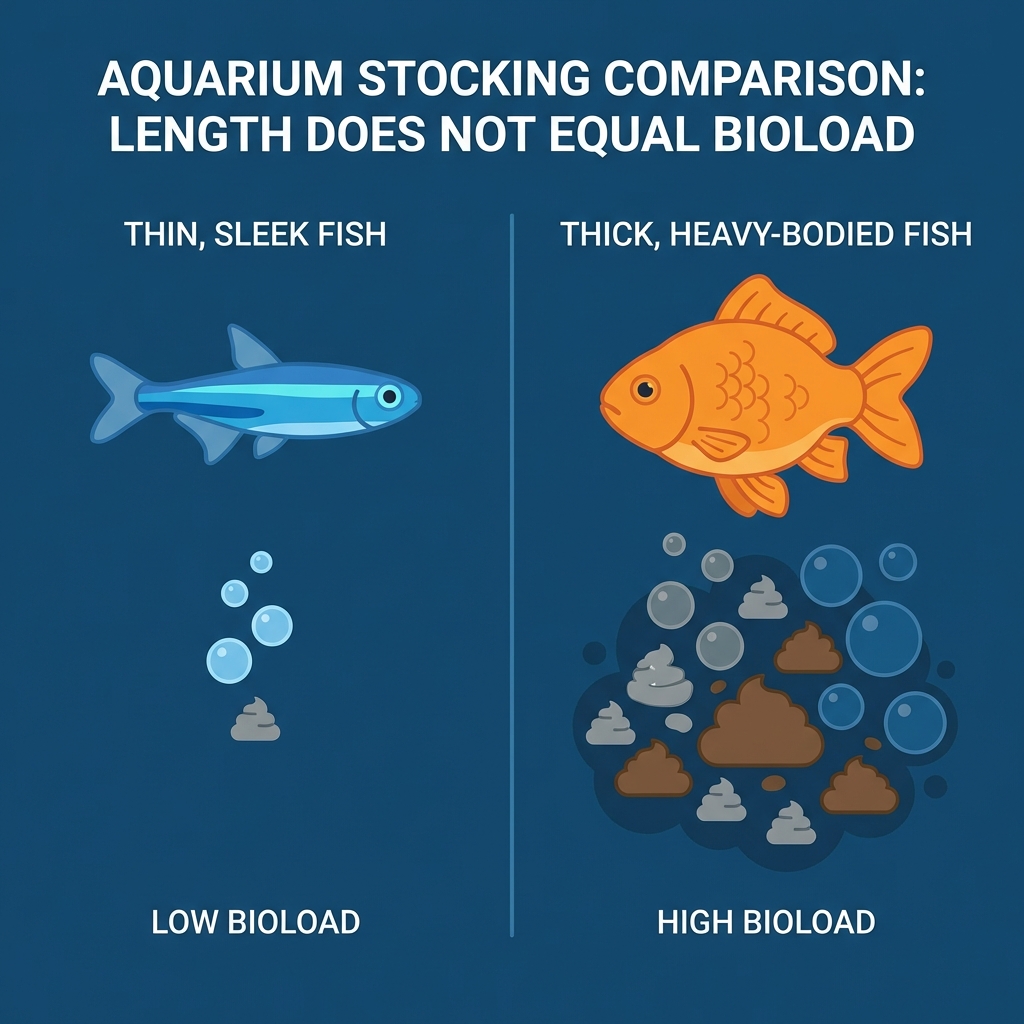
Think about it this way: Does a 10-inch Neon Tetra (if one existed!) have the same impact on a tank as a 10-inch Oscar fish? Definitely not. The Oscar is a thick, muscular fish that produces a massive amount of waste, while a thin tetra produces very little. The "inch per gallon" math also assumes adult size — that 1-inch baby angelfish becomes a 6-inch adult that needs 30+ gallons by itself.
Stocking a tank correctly is a balance of four factors: bioload (waste output), swimming space, social compatibility, and water-parameter compatibility. Get all four right and you have a stable, happy tank for years. Get any one wrong and you're constantly chasing problems. This guide gives you concrete numbers and rules of thumb that actually work, plus tank-size-specific examples for the most common setups.
Before you start picking fish, confirm your true tank volume on our Aquarium Volume Calculator — advertised sizes are approximate, and stocking math assumes real gallons after substrate and decor displacement (figure 85 to 90 percent of the listed volume is actual water).
Understand Fish Bioload and Waste Output
The most important factor isn't the length of the fish, but their mass and waste output (bioload). Some fish are "messy" eaters and poop machines; others are much cleaner. A useful mental model is the "thickness rule": a fish twice as thick as a tetra produces roughly four times the waste, even at the same length, because waste output scales with body mass, not length.
- High-bioload fish: Goldfish, Plecos, Oscars, large Cichlids, Discus. Plan for 2 to 4x the typical inch-per-gallon math — a single common goldfish realistically needs 30+ gallons of its own water.
- Medium-bioload fish: Angelfish, Gouramis, Mollies, Platies, Swordtails, smaller Cichlids. Standard sizing rules apply.
- Low-bioload fish: Tetras, Rasboras, Guppies, small Corydoras, Otocinclus, shrimp. You can stock these tighter than the rule suggests, especially in well-filtered planted tanks.
Better Stocking Rules to Use Instead
Three rules of thumb that work better than "1 inch per gallon":
- The 1 inch per 2 gallons rule for medium-sized community fish. A 20 gallon tank can comfortably support about 10 inches of total fish (think: six 1.5-inch tetras plus three 1-inch corydoras).
- The "adult size, not pet store size" rule. Always plan for the fish's adult size. A common pleco at the store is 3 inches; the same fish at three years old is 18 inches and needs a 100+ gallon tank.
- The schooling-fish minimum rule. Schooling fish (tetras, danios, rasboras, corydoras) need at least 6 of their own kind to feel secure. Two or three of a schooling species will hide constantly and may stress to death. Always count them in groups, not individuals.
Stocking by Tank Size: Real Examples
Here are realistic, balanced stocking lists for common tank sizes. These assume a properly cycled tank (see our Cycling Guide), adequate filtration (4 to 6x turnover, see our Filter Guide), and weekly maintenance.
5 to 10 gallon nano tanks
- 1 betta + 4 to 6 ember tetras + 2 amano shrimp
- OR: 8 to 10 chili rasboras (species-only tank)
- OR: a colony of cherry shrimp with a single nerite snail
- Avoid: goldfish, common plecos, any cichlids, multiple bettas
20 gallon long
- 8 neon tetras + 6 panda corydoras + 4 otocinclus
- OR: 1 dwarf gourami + 8 harlequin rasboras + 6 corydoras
- OR: trio of dwarf cichlids (apistogramma) with a school of dither tetras
40 gallon breeder
- 10 cardinal tetras + 6 corydoras + 8 ember tetras + 1 honey gourami
- OR: a pair of german blue rams + 12 rummy nose tetras + 6 corydoras
- OR: 8 to 10 small to medium tetras + 1 angelfish + 6 corydoras
55 gallon angelfish community
- 2 angelfish + 10 cardinal tetras + 6 sterbai corydoras + 1 bristlenose pleco
- OR: 4 angelfish species-only (2 bonded pairs) with heavy planting
- OR: 2 angelfish + 1 pair german blue rams + 10 rummy nose tetras + 6 corydoras
See the full guide: How Many Angelfish in a 55 Gallon Tank?
75 gallon community
- School of 15 to 20 cardinal tetras + 6 corydoras + 4 angelfish + a small group of dwarf cichlids
- OR: 1 fancy goldfish (with strong filtration and frequent water changes)
- OR: a "Mbuna" African cichlid setup with 12 to 15 mixed species (overstocking is intentional with these to reduce aggression)
125+ gallon "wet pets"
- 1 Oscar (alone, with strong filtration)
- OR: a small group of discus with cardinal tetras and corydoras
- OR: a community of larger South American cichlids and a pleco
The Surface Area Rule
Fish don't just need space to swim; they need oxygen! Oxygen enters the water at the surface through gas exchange. This means a shallow, wide tank can actually support more fish than a tall, narrow tank of the same volume because it has more surface area.
For example: a 20 gallon "long" tank (30" x 12" x 12") provides 360 square inches of surface. A 20 gallon "tall" or hex tank of the same volume might give you only 180 square inches. The long tank can comfortably support roughly twice the fish — same gallons, very different stocking capacity. This is also why surface agitation from your filter return is so important: a still surface chokes a tank's oxygen supply, while a rippling surface supports much more livestock.
Compatibility: It's Not Just Size
Two fish that fit volume-wise can still be a disaster. Always check:
- Temperature compatibility. Goldfish (65 to 72°F) and tropical community fish (76 to 78°F) cannot live together. Discus (84°F+) won't work with most cooler-water community fish. See our Heater Guide for species-specific temperatures.
- pH and water hardness. Soft-water Amazon species (tetras, discus, rams) struggle in hard alkaline water. African cichlids need hard alkaline water. Don't mix water-chemistry extremes.
- Aggression. Bettas and gouramis fight. Tiger barbs nip long-finned fish. Most cichlids cannot be kept with peaceful community species.
- Diet. Predatory fish (Oscars, larger cichlids) will eat any fish small enough to fit in their mouth, regardless of how peaceful they "look."
- Activity level. Fast schooling fish (zebra danios, tiger barbs) stress out slow gentle species (bettas, angelfish, gouramis).
Common Stocking Mistakes
The mistakes we see most often:
- Buying impulse fish at the store. The cute juvenile rainbow shark needs 50+ gallons as an adult. Research before you buy, not after.
- Trusting big-box pet store advice. Many staff mean well but don't keep fish themselves. The "10 gallon goldfish kit" is the most common example — goldfish need 30+ gallons.
- Skipping the cycle. Even moderate stocking will overwhelm an uncycled tank. Cycle first, stock second.
- Adding everyone at once. A bacterial colony cycled for 4 fish cannot suddenly handle 12. Stock in waves over 3 to 6 weeks.
- Ignoring schooling needs. Six neon tetras in a 20 gallon are happy. Two neon tetras in a 20 gallon are constantly stressed and prone to disease.
- Counting plecos as "cleaners." Common plecos grow to 18 inches and produce as much waste as the rest of the tank combined. They don't "clean" anything — they add bioload.
Check Your Tank Size
Before you buy fish, confirm your exact water volume using our Aquarium Volume Calculator.
You also need to understand the Nitrogen Cycle before adding a full school of fish.
The Surface Area Rule
Fish don't just need space to swim; they need oxygen! Oxygen enters the water at the surface. This means a shallow, wide tank can actually support more fish than a tall, narrow tank of the same volume because it has more surface area for gas exchange.
Check Your Tank Size
Before you buy fish, confirm your exact water volume using our Aquarium Volume Calculator.
You also need to understand the Nitrogen Cycle before adding a full school of fish.
Test Water Quality to Prevent Overstocking
No calculator is perfect. The only scientifically accurate way to know if your tank is overstocked is to check your water quality. Even a "perfectly stocked" tank by inch-rule math can be overstocked in practice if the filter undersizes, the aquarist feeds too heavily, or the fish grow larger than expected.
Target readings in a properly stocked, well-maintained tank:
- Ammonia: 0 ppm always. Anything above is a sign of overstocking, missed maintenance, or a cycle problem.
- Nitrite: 0 ppm always.
- Nitrate: Under 20 ppm ideally, under 40 ppm acceptable. If you're regularly above 40 ppm with weekly water changes, the tank is overstocked.
- Test weekly for the first three months after any new fish addition, then biweekly once stable.
The full weekly maintenance routine that supports a properly stocked tank is laid out in our Maintenance Schedule.
Frequently Asked Questions
How many fish can I put in a 10 gallon tank?
A reasonable nano stocking is one of: a betta with 4 to 6 small dither fish, a school of 8 to 10 micro rasboras (chili rasboras, ember tetras), or a small school of 6 endlers/least killifish. Avoid goldfish, multiple bettas, common plecos, and any cichlid in a 10 gallon — they need much more room.
Can goldfish live in a 10 gallon tank?
No. A single common goldfish needs at least 30 gallons; a fancy goldfish needs 20 to 30 gallons minimum, plus 10 more for each additional fish. Goldfish in 10 gallon tanks are stunted, stressed, and rarely live half their potential lifespan. See our Goldfish in 10 Gallon Tank guide for the full explanation.
How long should I wait between adding new fish?
Two to three weeks between groups. Add 25 to 30 percent of your final stock at a time, then watch your test kit for an ammonia or nitrite spike. If parameters stay 0/0, your bacteria colony has scaled up and you can add the next wave.
Do plants count toward stocking?
Plants don't add bioload — they reduce it by consuming ammonia and nitrate directly. A heavily planted tank can comfortably support 20 to 30 percent more fish than a bare tank of the same size. See our Live Plants for Beginners guide for easy starter species.
What's the easiest way to know if my tank is overstocked?
Three signs: (1) nitrates above 40 ppm even with weekly water changes, (2) any detectable ammonia or nitrite, or (3) fish constantly gasping at the surface. Any of these means too many fish for your filtration and maintenance routine.
Is the "1 inch per gallon" rule ever correct?
Roughly accurate only for small, slim community fish (tetras, rasboras, small barbs) in well-filtered tanks. It fails badly for bulky fish, schooling species (which need group sizes that violate the math), and any fish over about 4 inches. Use the better rules of thumb in this guide instead.
Essential Tool for Every Aquarist
The only way to know if you are overstocked is to test your water parameters weekly. If you're already seeing warning signs, read our overstocked aquarium guide for a complete diagnosis checklist.
Get the API Freshwater Master Test Kit on Amazon